
For several years now, high-speed CNC machining has been one of the areas that has had the greatest impact on the efficiency of modern manufacturing plants. With the development of high-speed machines, new tool geometries, and advanced CAM systems, an approach known as High Speed Machining (HSM) has emerged.
It is not just a matter of “working faster.” HSM changes the way we think about process preparation, tool load planning, and path control—especially where short cycle times, stability, and high surface quality are required.
That is why it is increasingly becoming the standard in industries working with demanding materials and complex geometries.
In the rest of this article, we describe the most important principles of HSM, how the process is carried out, and the areas where this method yields the most measurable results.
Table of Contents
High Speed Machining – basic definition
In the simplest terms, High Speed Machining (HSM) is a machining strategy in which:
- We use very high spindle speeds and high feed rates,
- we reduce the depth and width of the cut,
- we maintain as constant a tool load as possible throughout the entire path.
In many industrial applications, HSM is considered to be working at spindle speeds above 10,000 rpm and cutting speeds ranging from several hundred to over 1,000 m/min (depending on the material and tool geometry).
However, this is not a rigid limit – the key is the approach, i.e., high dynamics with a small, well-controlled chip cross-section.
High-speed CNC machining vs. conventional machining
In conventional machining, increasing productivity usually means more pressure – the cutting depth, tool engagement width, and cutting forces increase.
This leads to increased loads on the spindle, the clamping device, and the workpiece itself. The temperature in the cutting zone rises and the chip has relatively long contact with the cutting edge.
In high-speed CNC machining typical of HSM, the process is different:
- The tool makes very fast but light passes,
- the contact time between the blade and the material is shorter,
- a large part of the heat is removed with the chip,
- the instantaneous cutting forces are lower, which reduces the risk of deflection and vibration.
This approach works particularly well for complex 3D surfaces in parts such as molds and dies, in hardened materials, and for machining pockets and contours, where both productivity and surface quality are important.
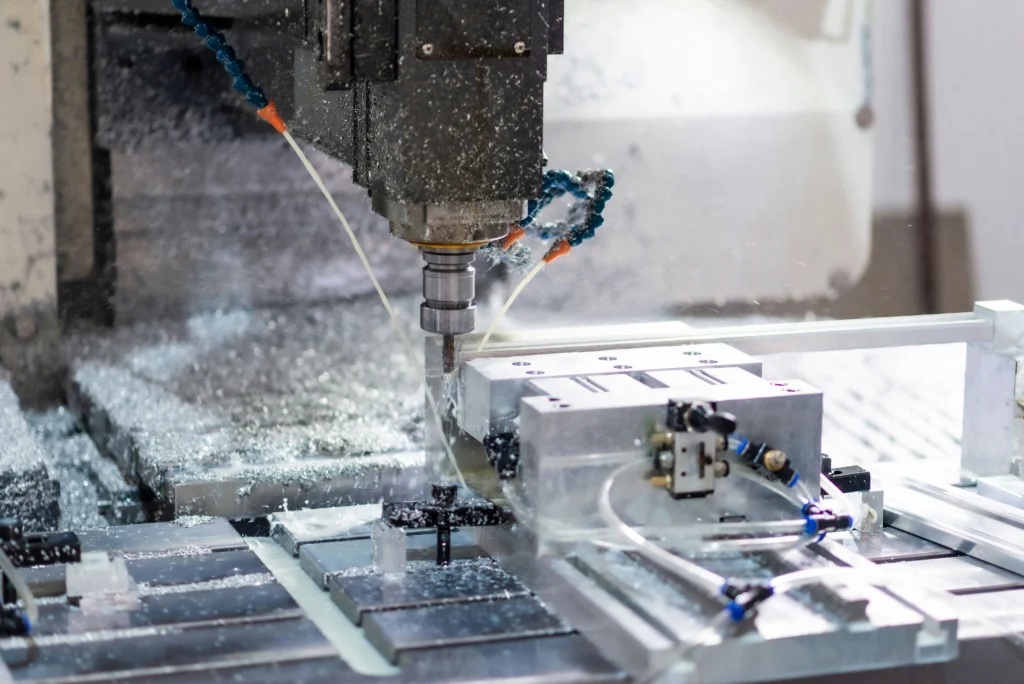
Tools, holders, and machines for HSM
High Speed Machining requires a tool-holder-machine system that is capable of operating stably at high dynamics and high rotational speeds. The key elements are:
- Tools – solid carbide, with coatings adapted to high cutting speeds and low cutting resistance geometry.
- Sharp edges, positive rake angles, and optimized tooth spacing reduce cutting forces and improve load distribution.
- Holders – shrink-fit, hydraulic, or other solutions with very good rigidity and balance.
- At speeds typical for HSM, even slight imbalance generates large centrifugal forces, which can lead to vibrations and loss of surface quality.
- Machine – machining center or lathe with a spindle designed for high speeds, sufficient power in the upper RPM range, high axis dynamics, and stable construction.
- Good control and fast interpolation are crucial for HSM paths to be executed according to CAM specifications.
The high dynamics of the entire process also make the quality of the workpiece clamping very important.
Any inaccuracy in the fixture, lack of support, or looseness in the clamping can result in instability and reduced dimensional accuracy.
Applications and benefits of High Speed Machining
HSM is particularly popular in industries where a combination of complex geometry, high accuracy, and difficult materials is important:
- Production of molds and dies (tool steels, hardened materials),
- aerospace, defense, and space components (aluminum alloys, titanium),
- precision components for machines and devices with complex geometry.
The main benefits are:
- Reduced cycle time while maintaining or improving surface quality,
- the ability to machine hard materials without the need for intensive finishing,
- more stable control of tool and workpiece temperature.
Limitations and challenges of HSM
High Speed Machining is not a universal solution for every workpiece and every machine. The main limitations include:
- The need for a rigid, dynamic machine with a suitable spindle,
- the increased importance of tool and holder balance – slight imbalance at high speeds generates high forces,
- the risk of chatter, which occurs when the combination of speed, tool length, and system rigidity is unfavorable.
Therefore, when implementing high-speed CNC machining, it is advisable to follow the recommendations of tool manufacturers and, where possible, use stability analyses to help select a spindle speed range that ensures smooth operation.
Summary
High Speed Machining (HSM) is a comprehensive approach to cutting – from the selection of the machine, tools, and holders, through path strategies, to parameter settings.
When used correctly, high-speed CNC machining can significantly reduce manufacturing time, improve surface quality, and increase process stability, especially with demanding materials and complex geometries.
However, the key to success is conscious implementation – with an assessment of the machine park, selection of the right details, and systematic improvement of parameters based on actual results, not just theoretical assumptions.