
In CNC machining, it is very easy to focus solely on cutting parameters, tool geometry or machine accuracy.
However, in practice, cooling and chip removal often determine whether the process remains stable throughout the entire production series.
These are not auxiliary elements. They are an integral part of the process that affects temperature, tool wear, material behaviour and quality repeatability.
Especially with long series or difficult geometries, a lack of control in this area quickly leads to problems that are difficult to link to a single specific cause.
Cooling and chip removal as elements of CNC machining process stability
CNC process stability means that, with constant parameters, we obtain a predictable result: the same dimensions, the same surface quality and similar tool wear.
For this to be possible, the conditions in the cutting zone must be as constant as possible.
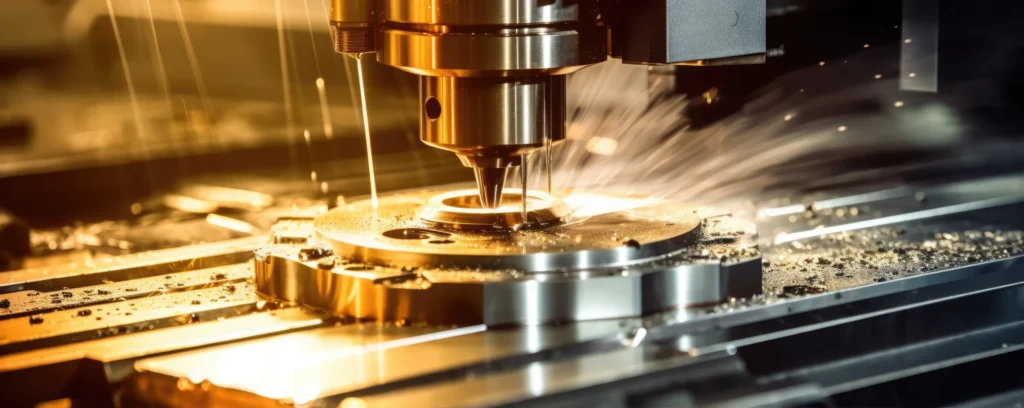
The coolant is responsible for heat removal, friction reduction and chip transport. Chip removal prevents them from coming into contact with the tool and workpiece again.
If any of these elements ceases to function properly, the process begins to “break down” – often gradually and imperceptibly.
The role of temperature and chips in long-term process stability
Chips remaining in the machining zone are one of the main sources of process variability. They can be re-cut, wedge between the blade and the material, or block the coolant flow.
As a result, the temperature rises locally and the cutting forces change.
This may not be noticeable in a short series. In long series production, however, it leads to a gradual deterioration in surface quality, an increase in dimensional variation and a reduction in tool life.
The influence of cooling conditions on the behaviour of tools and the material being machined
Stable cooling maintains predictable blade operating conditions. With insufficient or uneven cooling, the tool operates at a higher temperature, which promotes accelerated wear, microcracks on the edge and the formation of build-up.
The workpiece material also reacts to temperature changes. Especially in aluminium and alloy steels, changes in cooling conditions affect friction, chip formation and surface quality.
Thermal load on tools and machining repeatability
A tool subjected to variable thermal loads wears unevenly.
This means that even with the same programme parameters, the actual cutting conditions change over time. In practice, this manifests itself in dimensional drift or the need for corrections during a series.
Constant cooling conditions allow tool wear to be kept within a predictable range and replacement to be planned in a controlled manner, rather than only after deficiencies have arisen.
Material deformation resulting from improper cooling
An increase in temperature in the cutting zone causes the material to expand. After cooling, the part returns to its original dimensions, which can result in geometric errors.
This problem is particularly noticeable with thin-walled components, long workpieces and precision fits.
Uneven cooling also promotes the formation of internal stresses, which may only become apparent after machining or during further operations.
Chip removal in CNC machining as a process risk factor
Accumulated chips can periodically block the cutting edge, causing load spikes and momentary vibrations.
Each such disturbance accelerates tool wear and reduces the stability of the entire process, even if the parameters in the programme remain unchanged.
Chips as a cause of micro-damage to surfaces
Chips moving across the machined surface act as an abrasive material.
They cause scratches, pitting and local damage that is difficult to remove during the finishing stage. The problem is exacerbated in deep pockets and enclosed spaces.
The influence of workpiece geometry on chip behaviour during the process
The geometry of the workpiece largely determines how chips are evacuated. Narrow channels, deep pockets or sharp corners require a conscious choice of cooling strategy, tools and cutting direction to avoid chip accumulation.
Cooling and chip control strategies in the context of mass production stability
In series production, it is crucial to maintain identical cooling conditions for each workpiece.
This includes not only the pressure and direction of the coolant, but also its cleanliness and stability of parameters over time. Even slight changes can lead to quality differences within the same series.
The relationship between cooling strategy and process predictability
A well-chosen cooling and chip removal strategy increases process predictability.
It facilitates the planning of cycle times, tool changes and quality control. As a result, it reduces the number of downtimes and unplanned adjustments.
Summary
Cooling and chip removal in CNC machining are key factors in process stability and product quality.
Their role increases with the length of the series, the complexity of the geometry and the quality requirements.
Conscious design of these elements allows you to reduce variability, improve repeatability and increase process safety. It is these details that determine whether CNC machining remains stable not only on the first, but also on the thousandth detail.