
CNC machining in the medical industry is one of the most demanding areas of manufacturing. In this context, build quality and process repeatability are of critical importance, as the components are used in demanding technical applications.
Parameters such as surface roughness and process cleanliness are of key importance here, as they directly affect the safety of the parts’ use.
Why is CNC machining in the medical field so demanding?
Manufacturing for the medical sector differs from standard industrial production primarily in terms of the level of responsibility. Components such as surgical instruments or implant parts must be completely safe when in contact with the human body.
It is not just about the material, but also its finish. Even minor surface imperfections can affect the durability and safety of the component.
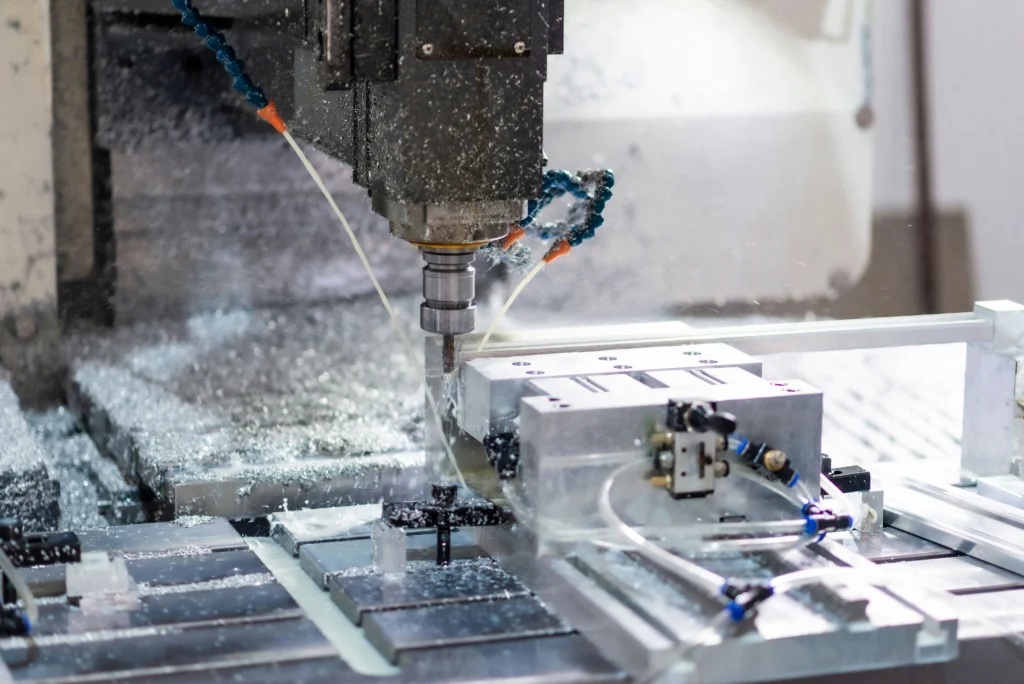
The importance of surface quality in CNC machining for the medical industry
It is precisely at the surface finishing stage that the difference between standard machining and production for the medical industry is most often evident.
The greatest challenge is not the fabrication of the part itself, but achieving the appropriate surface quality. Every scratch, microcrack, or irregularity can:
- Promote corrosion,
- hinder sterilization,
- serve as a site for contamination accumulation.
This means a higher risk of operational issues and difficulties in maintaining the required cleanliness of the part during use.
That is why medical manufacturing strives for a surface that is as smooth as possible and easy to clean.
Surface roughness in CNC machining
Surface roughness determines how much a given surface deviates from being perfectly smooth. The Ra parameter, which describes the average surface roughness, most commonly appears in documentation.
Which values matter
In standard industrial manufacturing, Ra values of approximately 1.25 µm are considered acceptable. In the medical industry, requirements are significantly higher—often below 0.4 µm, and even lower for certain components.
For the end user, this means:
- Less friction,
- greater operational precision,
- and a lower risk of tissue damage.
This translates to greater safety of use and better control over the operation of the tool or implant.
Sterilization and surface quality after CNC machining
Excessive roughness can hinder effective sterilization. Contaminants can remain in microscopic irregularities, which are difficult to remove even in high-pressure processes.
Therefore, additional finishing processes are used, such as:
- Polishing,
- grinding,
- vibratory finishing.
The selection of the appropriate finishing process depends on the requirements of the specific component and its application.
Material Challenges in CNC Machining for the Medical Industry
Materials used in the medical industry, such as stainless steels, titanium, or certain engineering plastics, are among the most difficult to machine. Their machining requires greater temperature control, stable cutting parameters, and the appropriate selection of tools.
A lack of control over these factors can lead to a deterioration in surface quality and instability of the entire process.
We discuss the topic of machining difficult materials in more detail in the article: “CNC Machining of stainless and acid-resistant steel – technological challenges in demanding conditions”.
Temperature control and process stability in CNC machining
During machining, some materials heat up faster than standard structural steels. If the process is unstable, this can lead to a deterioration in surface quality or changes in the material’s structure.
Therefore, proper cooling, control of cutting parameters, and process repeatability are particularly important. Only the combination of these elements allows for maintaining stable part quality in mass production.
We describe quality control and measurement methods in more detail in the article: “How to measure workpieces in CNC machining? Measurement methods and their applications”.
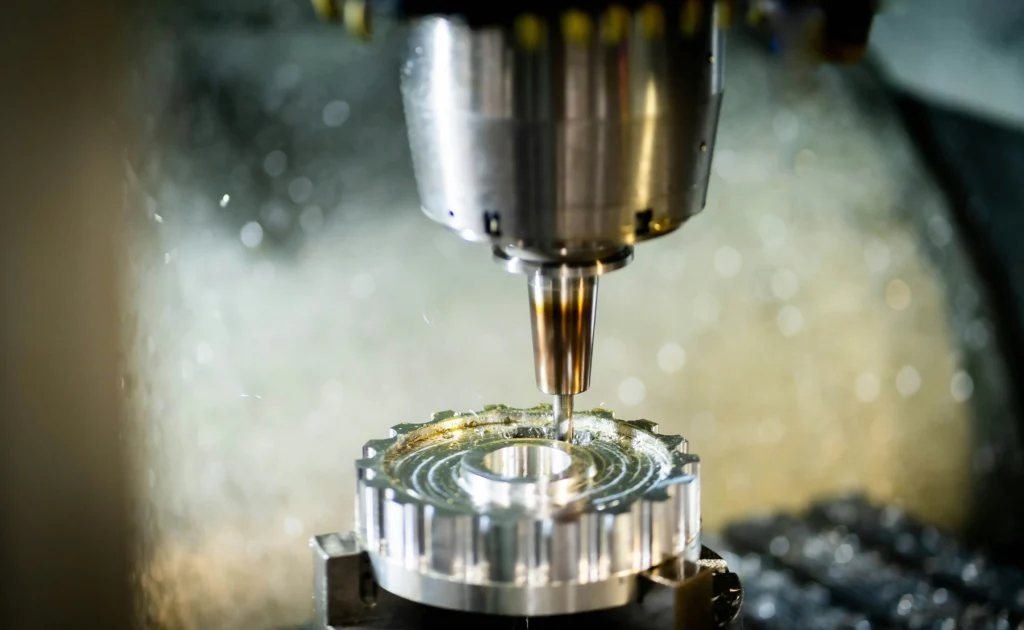
Surface finish
CNC machining itself is only part of the process. Finishing operations, such as deburring and edge smoothing, are also of great importance.
In medical components, even very small imperfections can pose a risk, which is why the final surface quality is just as important as dimensional accuracy.
Process cleanliness in CNC machining
Part cleanliness is not limited to the absence of visible contaminants. It is also crucial to remove residues from the machining process, such as oils, coolants, or material particles.
In medical manufacturing, special technological measures are employed, the cleaning process is controlled, and the material is verified as early as the production intake stage.
Material inspection
To ensure the quality of the part, material inspection is also crucial. This involves verifying its composition and compliance with requirements even before production begins.
Process cleanliness and material inspection are crucial for ensuring the quality and safety of medical components.
Summary
The production of components for the medical industry requires a combination of precise CNC machining, quality control, and appropriate finishing processes.
High requirements regarding surface roughness and cleanliness stem directly from the need to ensure the safe use of parts.
Projects for the medical industry require special surface quality control and process stability.
At SIM Gdynia, we manufacture parts where precise CNC machining and finish quality are critical to the safety and reliability of the components.