
Castings are widely used as semi-finished products for manufacturing components across many industries. They reduce the amount of material that must be removed and shorten machining time, but they also present manufacturing engineers with challenges that differ from those associated with rolled stock or bar material.
With castings, the actual geometry of the workpiece may differ from the nominal CAD model. Surface irregularities, local distortions and variations between production batches mean that CNC machining requires careful process planning from the very beginning. How can you account for casting variability while maintaining the required quality of the finished component?
Table of Contents
Why Does CNC Machining of Cast Components Require a Different Approach?
Unlike rolled or forged materials, every casting can differ slightly from the previous one. The shape and machining allowance distribution are not always identical. Even when castings are produced from the same documentation, small differences between individual parts may affect subsequent CNC machining operations.
For the manufacturing engineer, this means evaluating not only the geometry of the finished component but also the actual condition of the casting itself. Decisions regarding datum selection, machining sequence and overall process preparation are made at this stage.
When machining castings, process consistency is the key factor. A well-planned manufacturing strategy minimizes the influence of natural variations between castings and ensures repeatable production.
For more than 45 years, we have been developing our expertise in manufacturing precision mechanical components, continuously investing in machining equipment, inspection capabilities and the development of our engineering team. This allows us to deliver demanding projects for customers across a wide range of industries.
How Does Casting Variability Affect CNC Machining Preparation?
Every machining process begins with evaluating the semi-finished workpiece. It is important not only to verify whether the casting matches the documentation but also whether sufficient machining allowance is available to produce all required surfaces according to specification.
Already at this stage, it is possible to identify features that may affect the CNC machining process and determine the most appropriate manufacturing strategy.
Machining Allowances and the Actual Position of Surfaces
The nominal machining allowance specified in the documentation does not always correspond to the actual amount of material available on a particular casting. In some areas it may be larger or smaller, while certain surfaces may be shifted relative to the CAD model.
If these deviations are not considered during process planning, unmachined areas may remain on the finished component or, conversely, too much material may be removed.
For this reason, before CNC machining begins, it is worth verifying whether sufficient machining allowance is available in all critical areas of the component. This significantly reduces the risk of problems during subsequent machining operations.
Distortion and Differences Between Individual Castings
Minor distortions and dimensional differences between casting batches are a natural occurrence. Their extent depends on factors such as the manufacturing process, the material and the overall size of the casting.
This does not mean that every casting requires an individually prepared machining program. Far more important is designing a process that accommodates acceptable casting variation while maintaining production repeatability.
A properly developed manufacturing process should be robust enough to tolerate the typical deviations occurring between individual castings. As a result, production remains stable and finished components consistently meet documentation requirements.
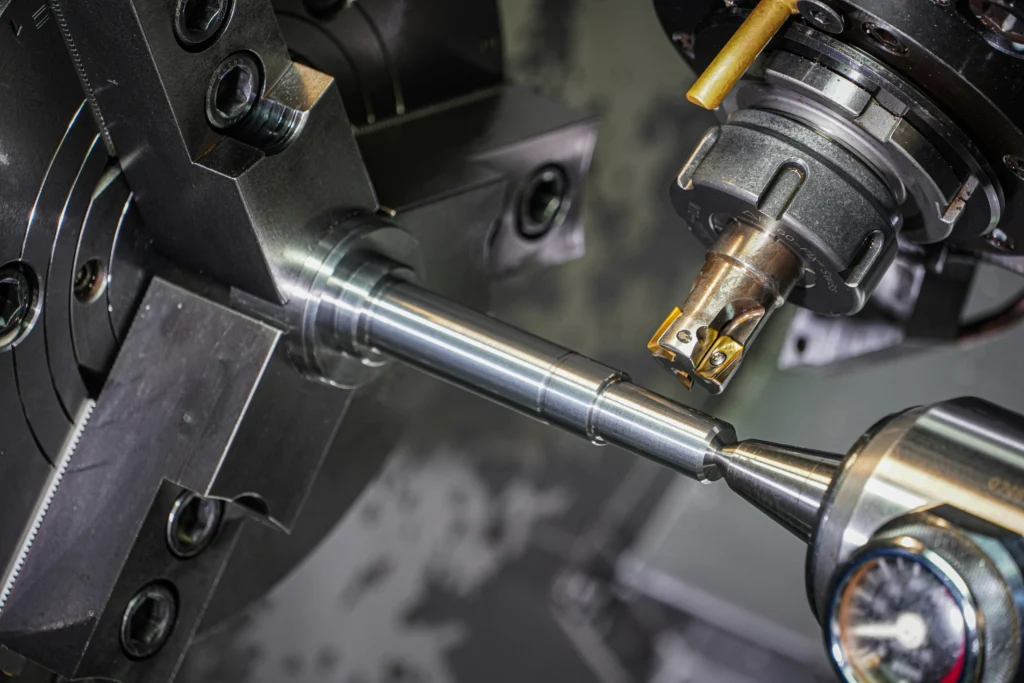
How Should Cast Components Be Properly Located and Clamped?
The locating strategy directly affects the dimensional accuracy of the finished component. With castings, raw surfaces are often neither perfectly flat nor parallel, making the selection of suitable reference surfaces particularly important.
Proper workpiece location minimizes the influence of casting irregularities on subsequent CNC machining operations.
Selecting Reference Surfaces
Reference surfaces should provide stable positioning while allowing all required features to be machined according to the technical documentation.
This means selecting areas of the casting that exhibit the lowest variability and ensure the correct position of machined features.
Already during process planning, it is worth analysing which surfaces are best suited as machining datums. Choosing the right reference points improves repeatability and reduces the risk of errors during subsequent setups.
The Importance of the First Machining Operation
The first machining operation often determines the success of the entire manufacturing process. It creates the reference surfaces that become precise technological datums during later setups.
The quality of the initial setup directly influences all subsequent CNC machining operations. Properly machined reference surfaces make it much easier to maintain the required dimensional accuracy throughout the process.
You can learn more about production planning in our article “From documentation to stable production – the work of a technologist at SIM Gdynia“.
How Can the Impact of Casting Variability on Component Quality Be Reduced?
Completely eliminating differences between castings is not always possible. However, the manufacturing process can be designed to accommodate these variations.
In practice, this includes:
- Selecting appropriate machining datums,
- inspecting the first manufactured parts,
- verifying machining allowance availability,
- maintaining the correct machining sequence,
- continuously monitoring production repeatability between batches.
In our daily work, we often encounter projects where the biggest challenge is not the CNC machining itself but preparing a process suited to a specific type of casting. Experience gained from a wide variety of projects allows us to identify potential issues long before production begins.
Inspection of Cast Components Before and After CNC Machining
Inspection starts before the cutting tool makes its first pass. Depending on the project, this may include verifying casting dimensions, available machining allowances and the position of the most critical surfaces.
For more demanding components, this early inspection makes it possible to determine whether casting variability could prevent the part from being manufactured according to the technical documentation. Identifying such issues early helps avoid unnecessary production downtime.
After CNC machining is completed, the finished component is inspected to verify compliance with the technical documentation. This confirms that, despite the natural variability of the casting, the finished part meets all project requirements.
You can learn more about our inspection process in the article “Quality control in CNC machining – how do we ensure precision at SIM Gdynia?“.
Summary
Castings are an efficient way to prepare semi-finished products for manufacturing a wide range of components. However, their natural variability requires a carefully planned technological approach.
The key factors are proper evaluation of machining allowances, correct datum selection, stable fixturing and inspection of the first manufactured components.
Only by combining these elements is it possible to establish a repeatable and precise CNC machining process. A well-designed manufacturing strategy minimizes the influence of differences between individual castings while maintaining consistently high component quality.
If you are planning to outsource the CNC machining of cast components, contact us. We will help analyse your documentation and prepare a manufacturing process tailored to the specific requirements of your project.