
CNC machining of more complex components often requires multiple setups. This is due to the need to machine surfaces on different sides of a part, its geometry and limited tool accessibility. Every change of setup carries a risk of deviations that may affect the accuracy of the finished component.
When manufacturing such parts, maintaining the correct position of individual surfaces relative to one another becomes particularly important. This requires careful planning of subsequent operations, accurate workpiece referencing and inspection at different stages of CNC machining.
Table of Contents
Why Do Some Parts Require Multiple Setups During CNC Machining?
The need to change the workpiece setup results primarily from the component’s geometry. For more complex parts, accessing all the required surfaces with a cutting tool in a single setup is not always possible.
Multiple setups may be necessary for parts machined from different sides, components with surfaces located in different planes or parts that require changes to the support arrangement. However, each additional setup means establishing the workpiece position again. Therefore, the division of CNC machining into individual operations should be planned before production begins.
What Affects Accuracy Between Successive Setups in CNC Machining?
Component accuracy depends on maintaining both the required dimensions and the relative positions of surfaces machined in different setups. Even a small shift when repositioning a part can affect whether the finished component meets the technical documentation requirements.
Factors that may influence the result include the referencing method, repositioning accuracy, the condition of surfaces used as datums and the stability of the clamping system. A minor deviation introduced during one operation may affect surfaces machined at later stages.
Workpiece Referencing and Maintaining Datum References
Datums define the component’s position during successive stages of CNC machining. They should allow the workpiece to be positioned repeatedly while maintaining the required geometric relationships.
The first operation is particularly important, as it may create surfaces that will later serve as references. Their accuracy affects how the component is positioned in subsequent setups.
Requirements concerning datums and tolerances should be clearly specified in the technical documentation. We discuss the information needed to prepare for production in more detail in our article “CNC Machining Based on Customer Documentation – What Is Required to Prepare Production?“.
Workpiece Positioning and Clamping Accuracy
After changing the setup, the workpiece must be placed in a precisely defined position. Both the locating method and the surfaces that come into contact with the clamping elements are important.
The cleanliness of datum surfaces also matters. A chip or other contamination left on a contact surface may affect workpiece positioning and the dimensions produced during the next operation. At the same time, the clamping system must provide stability during cutting without causing unwanted deformation.
How to Plan Successive Workpiece Setups in CNC Machining
Dividing the process into multiple setups requires consideration of the part’s geometry, tolerances and relative surface positions. It is particularly important to determine which features should be machined first and which datums should be used during subsequent operations.
At SIM Gdynia, we have been manufacturing mechanical components for over 45 years. When working with more complex parts, we apply this experience from the process planning stage, where technical documentation requirements must be aligned with the practical possibilities of machining individual surfaces.
We discuss the preparation of such operations in more detail in our article “From Documentation to Stable Production – The Role of a Manufacturing Engineer at SIM Gdynia“.
Sequence of Operations and Access to Machined Surfaces
The CNC machining sequence should provide tool access to the required areas while preserving the surfaces needed for subsequent referencing and clamping.
If several features have particularly demanding positional requirements relative to one another, machining them in the same setup may be beneficial, provided the part geometry and machine capabilities allow it. This reduces the influence of errors caused by repositioning the component.
In other cases, the process should be divided so that each successive setup has a clearly defined and repeatable reference to previously machined surfaces.
Reducing Errors When Repositioning the Workpiece
Reducing errors requires properly prepared datums, repeatable clamping conditions and inspection of the surfaces used to locate the workpiece.
For more demanding components, it is also worth planning inspections at earlier stages of production. This makes it possible to detect deviations before subsequent operations are carried out.
From our experience, when machining parts in multiple setups, it is essential to treat successive operations as one integrated process rather than independent stages.
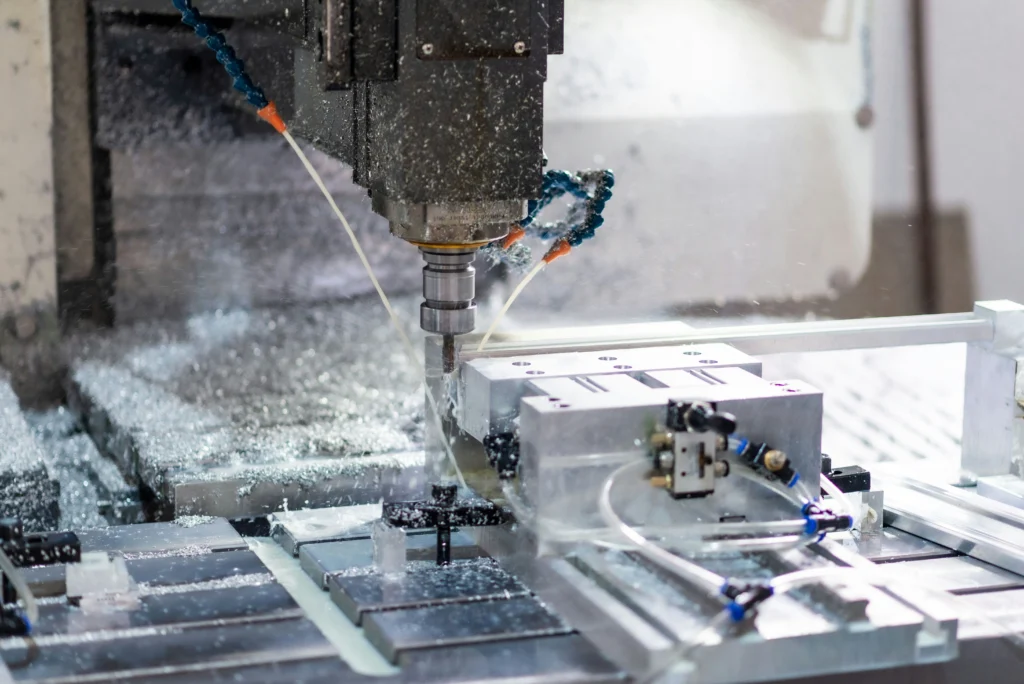
What Problems Can Occur During CNC Machining in Multiple Setups?
Every change of setup carries a risk of deviations that may affect the accuracy of the finished component. The most common problems include:
- Workpiece displacement or changes in orientation – these may lead to errors in the relative positions of surfaces machined in different setups.
- Inaccurate referencing – this makes it difficult to maintain repeatable workpiece positioning during subsequent operations.
- Contamination of contact surfaces – chips left behind may cause incorrect component positioning.
- Deformation during clamping – particularly in less rigid parts, this may affect the final component geometry.
The risk of errors increases with the number of setups. Therefore, when planning CNC machining, it is worth minimising their number wherever the part geometry and available manufacturing capabilities allow it.
Inspecting Component Accuracy Between Successive CNC Machining Operations
Inspection at individual production stages makes it possible to detect deviations before subsequent operations begin. For parts requiring multiple setups, it is particularly important to check the dimensions and surfaces that will be used during the next setup.
The scope of inspection depends on the technical documentation and component geometry. In addition to basic dimensions, it may also be necessary to verify the relative positions of surfaces machined in different setups.
At SIM Gdynia, we have more than 800 measuring instruments, allowing us to select inspection methods according to the component geometry and the requirements specified in the technical documentation.
Summary
CNC machining of parts requiring multiple setups demands a carefully coordinated approach to workpiece referencing, operation sequencing, stable clamping and inspection. Every repositioning of the component may affect its final accuracy, which is why successive stages should be treated as parts of one integrated manufacturing process.
Proper planning of successive setups helps reduce errors caused by repositioning and maintain the required geometric relationships between surfaces machined during different operations. Maintaining suitable datums and inspecting critical dimensions at the appropriate production stages are particularly important.
Does your component require CNC machining in multiple setups? Contact us to discuss the available manufacturing options.