There is no room for compromise in modern industrial production, which is why quality control in CNC machining is the foundation of every project carried out at our plant.
At SIM Gdynia, based on over 45 years of experience, we know that even the most advanced machining centres require rigorous supervision to guarantee the highest quality of mechanical components.
The role of a quality controller in CNC machining
A quality controller at SIM Gdynia is a person who links the design documentation with the actual detail.
Their work begins long before the finished component is shipped. They are a partner to the machine setter – it is the controller who decides whether the first piece in a batch meets strict technical standards.
In our practice, this process is dynamic: the controller receives the part, takes measurements and provides feedback to the production department.
If the dimensions are within tolerance, the “green light” is given for the entire series.
If any deviations are detected, the inspector indicates the necessary corrections, which helps to avoid material losses and ensures operational continuity. Such close cooperation between departments is crucial for building the company’s authority as a reliable supplier.
From calipers to “gates” – the quality control process at our production plant
The selection of measuring tools depends on the complexity of the part’s geometry and the required precision. At SIM Gdynia, we use a technological process that allows us to validate even the most demanding orders.
| Measuring instrument | Technical application | Role in the process |
| Digital calliper | Workshop measurements, verification of basic linear dimensions. | Quick inter-operational control at the machine. |
| Height gauge | Precise determination of height, distance between planes and hole axes. | Verification of parts with a more complex vertical structure. |
| Mitutoyo CMM machine | 3D coordinate measurements for complex solids and curves. | Final validation of parts with the highest degree of difficulty and dimensions up to 1000 kg. |
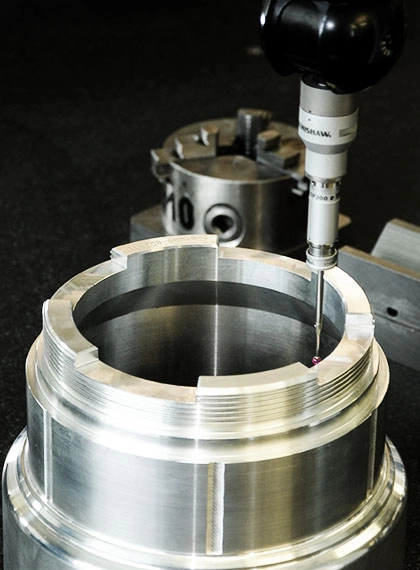
Our measuring machine allows us to digitally map the geometry of a detail and compare it with a CAD model. This ensures that every hole, thread or milling is exactly where the engineer planned it to be. Before starting the machining process, we often perform a spectrometric analysis of the chemical composition of the materials, which eliminates the risk of using raw materials that do not comply with the specifications.
Step-by-step control process
In accordance with the principle of continuous optimisation, quality control at SIM Gdynia is a closed, multi-stage process:
- Initial verification: Detailed measurement of the first piece from the batch and authorisation of the process by the inspector.
- Process monitoring: Regular checking of details during machining on CNC machines to detect tool wear.
- Post-processing control: Checking components after finishing processes such as deburring, shot blasting or grinding.
- Final audit in the metalworking shop: Final verification before packaging, including visual inspection and checking of coatings (e.g. galvanising or anodising).
Implementing this sequence of actions allows us to minimise the risk of products that do not meet production specifications.
Summary
Quality control is not just a dry measurement of dimensions – it is a comprehensive production risk management strategy.
At SIM Gdynia, the inspector guarantees that the components leaving our plant will work reliably for years to come. By combining experienced staff with modern Mitutoyo metrology technology, we provide solutions that build a lasting competitive advantage for our customers.
Do you want to be sure that your components will be manufactured with the highest precision? Contact our experts and find out how our control procedures can support your project.