
Serial production in CNC machining very quickly verifies all technological decisions.
What works acceptably in a short series or prototype begins to generate real costs in a long production cycle: shortages, corrections, downtime and accelerated tool wear.
Therefore, reducing costs in serial production is not simply a matter of increasing parameters or shortening cycle times, but of consciously designing a stable process.
In practice, the cheapest part is not the one made the fastest, but the one that is produced repeatedly – without quality surprises and unplanned interventions during the series.
Serial production in CNC machining as a system of interrelated technological decisions
Serial production is a system in which each decision affects subsequent stages: from the selection of semi-finished products, through the machining strategy, to quality control.
The larger the scale of production, the more pronounced the effects of even minor errors at the planning stage.
Production scale and process variability
As the number of parts increases, the importance of process variability increases. Minimal differences in tool wear, temperature or clamping rigidity begin to accumulate.
A process that looks correct for the first 20 pieces may generate deviations outside the tolerance after several hundred.
The balance between performance and stability
One of the key challenges is to find a balance between aggressive efficiency and stability. Overly conservative parameters increase the unit cost, but overly aggressive ones lead to:
- A sharp increase in tool wear,
- unstable cutting forces and vibrations,
- the need for frequent adjustments and downtime.
Cost optimisation in series production should always start with stability and only then move on to cycle time reduction.
A poorly chosen machining strategy, an inappropriate tool or failure to take process tolerances into account result in costs that only become apparent over time. In series production, such errors are repeated hundreds or thousands of times.
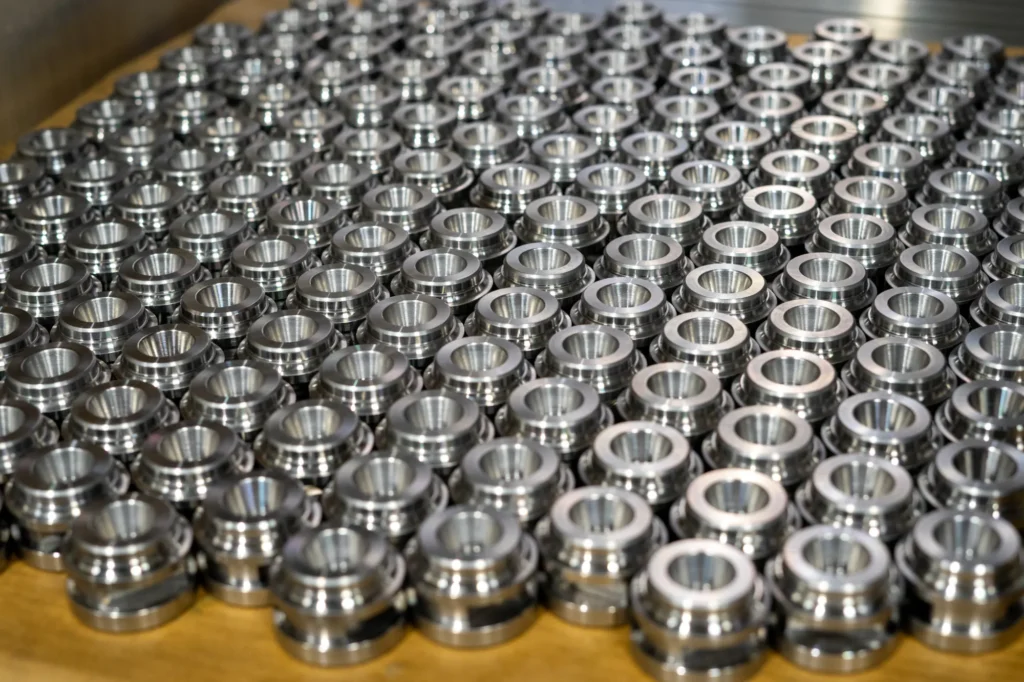
Machine park and tools in the context of production predictability
In series production, the predictability of machine operation is crucial. Differences in axis rigidity, spindle condition or feed dynamics have a direct impact on quality.
Tool wear is one of the main factors destabilising the process. If it is not monitored and planned, it leads to uncontrolled dimensional changes. An effective mass production strategy assumes:
- Predictable tool replacement intervals,
- stable cooling conditions,
- avoiding tool operation at load limits.
A well-chosen machining strategy reduces cutting force fluctuations and stabilises the process. Constant tool engagement, smooth entries and exits, and avoiding sudden load changes are often more important than maximum instantaneous performance.
Quality control in CNC series production as an element of optimisation
Quality control in series production should not be treated solely as a tool for detecting defects. Its main purpose is to quickly identify trends and prevent problems from escalating.
Insufficiently frequent inspections mean the risk of producing a large batch of non-compliant parts.
Effective quality control in CNC includes measurements of the first pieces after retooling, periodic checks during the series, and analysis of trends, not just limit values.
This makes it possible to react before deviations translate into real losses.
Summary
Serial production in CNC machining is a process in which costs and quality are closely linked. Attempts to reduce costs without understanding the stability of the process usually lead to the opposite of the intended effect.
The greatest potential for optimisation lies in conscious planning: the selection of machining strategies, tools, machines and quality control systems.