Mechanical assembly in modern industry is increasingly becoming integrated with the manufacturing process instead of functioning as a separate stage. More and more companies are asking whether it is better to coordinate multiple suppliers or outsource the production of a complete module to a single partner.
From our experience, combining CNC machining and assembly helps reduce fitting issues between components and simplifies production management.
Is It Worth Combining CNC Machining and Assembly in One Place?
In the traditional production model, individual components are manufactured by different suppliers. Only after delivery are they assembled and completed at the customer’s facility.
This model requires coordination of multiple orders, shipments, and quality control stages. Each of these elements increases the risk of errors and makes it harder to maintain control over the entire process. As a result, the likelihood of delays and inconsistencies between suppliers grows.
Reducing Organizational Costs
Outsourcing the production of a complete module simplifies production management. Instead of handling multiple ERP entries and coordinating several purchase orders, you work with one consistent production order.
It also reduces the number of administrative operations related to order processing and delivery control. This is especially important in projects involving a large number of components that require coordination between multiple suppliers.
Shorter Lead Times in CNC Machining and Assembly Processes
In an integrated model, the process runs more smoothly because components move directly from one production stage to the next without the need to organize transportation between suppliers. This eliminates downtime and reduces waiting times for subsequent operations, resulting in faster project completion.
Reducing lead times is important not only operationally but also from a business perspective. It allows products to be introduced to the market faster and helps minimize costs associated with production downtime or project delays.
Fits and Tolerances in CNC Machining – One Supplier, One Responsibility
Most assembly problems occur where components produced by different suppliers must fit together. Even small differences in tolerances can prevent proper assembly of a subassembly.
In such cases, the issue is not caused by a single mistake, but by the accumulation of minor deviations that only become visible during final assembly.
We discuss the topic of tolerances and component fitting in more detail in the article: “Dimensional Tolerances and Fits – How to Optimize IT Classes in CNC Machining to avoid Overpaying?”
Eliminating Assembly Issues
When an entire module is handled by a single supplier, tolerances are adjusted already at the production stage, and any deviations can be corrected immediately. Components are verified as a complete system, which helps avoid assembly problems later on.
This is especially important in serial production, where assembly repeatability directly affects production time and costs.
Quality Control of the Entire Subassembly
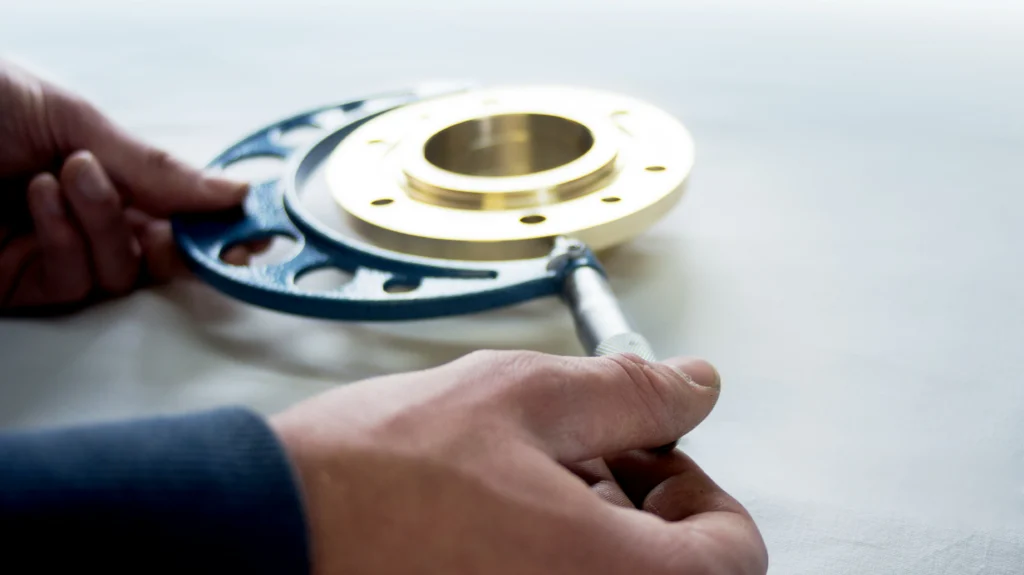
Quality control for a finished subassembly includes not only checking individual dimensions but also verifying overall functionality. Fits, movement resistance, and — if required by the project — sealing performance are tested. Thanks to this, the completed module can be used directly in further production stages.
We describe quality control and measurement methods in more detail in the article: “How to measure workpieces in CNC machining? Measurement methods and their applications.”
How Production and Assembly Integration Impacts the Project
Combining CNC machining and assembly allows for a broader perspective on the entire production process. In practice, this means the possibility of simplifying the design or selecting technologies more effectively.
Integration of CNC Machining and Assembly Processes
In the integrated model, one supplier is responsible for the entire process — from CNC machining and finishing operations to part preparation and final assembly. This approach makes production planning easier and reduces unnecessary operations.
As a result, subsequent production stages are better aligned, and the number of intermediate operations is minimized. This has a direct impact on overall process efficiency.
Management of Standard Components
As part of the module production process, procurement of standard components is also handled, including:
- Screws,
- washers,
- bearings,
- seals.
This allows the entire subassembly to be produced as one cohesive order. It reduces the risk of using incorrect components and simplifies quality control of the complete assembly.
Where Errors Occur in CNC Machining and Assembly Projects
In demanding industries such as energy or heavy machinery, failure of a single component can lead to serious consequences.
In more complex assemblies, even small errors may result in operational issues or the need for modifications during assembly. Most often, these problems arise from discrepancies between documentation and the actual execution of parts by different suppliers.
The Importance of Process Control
In the integrated model, assembly takes place in controlled conditions, reducing the risk of contamination and enabling material verification at different stages of the process. As a result, finished subassemblies are more repeatable and less prone to operational errors.
Why the Price of a Single Part Is Not the Total Project Cost
The cost of an individual component is only part of the overall project cost. Storage costs, assembly organization, team working time, and the risk of errors and rework are equally important.
Only by considering all these factors can the actual total production cost be properly evaluated. For this reason, cost analysis should include the entire project lifecycle, not just the price of a single component.
Summary
Outsourcing mechanical assembly together with CNC machining helps simplify production organization, shorten lead times, and reduce the risk of errors at component interfaces. This results in greater process predictability and improved quality control of the finished subassembly.
For more complex assemblies, consistency throughout the entire process — from CNC machining to final assembly — is essential.
At SIM Gdynia, we provide production and assembly of components, ensuring proper fit, repeatability, and compliance with project requirements.