
Threads are among the most commonly manufactured features in mechanical component production. They are used in simple assembly parts as well as housings, enclosures, and components operating in demanding industrial environments.
Although threading may seem like a standard machining operation, even minor errors can cause problems during assembly. As a result, a part that meets dimensional requirements may still fail to perform correctly in its intended application.
For this reason, CNC machining of threaded parts requires not only a properly designed manufacturing process but also effective quality control.
Table of Contents
Why Thread Quality Matters in CNC Machining
Threads are responsible for ensuring a reliable connection between components. If a thread is manufactured incorrectly, the problem often becomes apparent only during assembly or the initial operation of the equipment.
In many cases, minor damage to the thread profile, poor surface quality, or geometric deviations are enough to prevent a screw from being installed correctly.
Thread quality is particularly important for components exposed to operational loads, applications requiring leak-tight connections, and parts designed for repeated assembly and disassembly.
Where Thread Defects Most Commonly Become Apparent
Not every thread-related problem is visible immediately after CNC machining. Based on our experience, many defects only become apparent during the assembly of finished components, when the connection fails to meet the specified requirements.
The most common issues include:
- Incorrect tightening of components,
- loosening of the connection during operation,
- insufficient durability of the threaded connection,
- problems with proper component assembly,
- improper interaction between components after assembly.
For a single part, such a problem usually means additional assembly work or the need for rework. In larger production batches, the same defect may affect multiple components, leading to additional inspections, delays, and higher project costs.
For this reason, thread quality should be treated as one of the factors affecting the functionality of the finished product rather than simply another manufacturing operation.
The Most Common Problems When Producing Threads in CNC Machining
The final result of CNC threading depends on many factors related to both workpiece preparation and the machining process itself.
In our work, we often encounter situations where thread problems are caused not by one major error but by several seemingly minor deviations occurring at different stages of production.
Hole Preparation and Tool Condition
One of the most common errors is improper preparation of the hole before threading. Even minor deviations in diameter, alignment, or surface quality can affect the machining process and the quality of the finished connection.
Errors introduced at this stage are difficult to correct during subsequent operations, which is why proper workpiece preparation is essential for producing a correct thread.
Tool condition is equally important. As tools wear, thread quality deteriorates and the risk of defects increases. This is particularly relevant in serial production, where tools perform a large number of machining cycles.
For this reason, monitoring tool condition is one of the key elements in maintaining stable production quality.
Thread Damage and Chip Evacuation Problems
Another common source of problems is chips remaining in the machining zone. They can damage the thread surface or reduce the quality of subsequent thread turns. This issue is particularly common when producing deeper threads and machining materials that generate long, difficult-to-evacuate chips.
The first thread turns are especially vulnerable because they are responsible for ensuring proper engagement during assembly. Even minor damage in this area can cause problems when joining components. Effective chip evacuation from the machining zone is therefore particularly important when producing deeper threads and in serial production.
Similar relationships can also be observed in other precision machining operations. We discuss them in more detail in the article: “Precise hole machining in CNC machining – drilling, reaming, and boring in practice”
Thread Inspection and Consistent Quality in CNC Serial Production
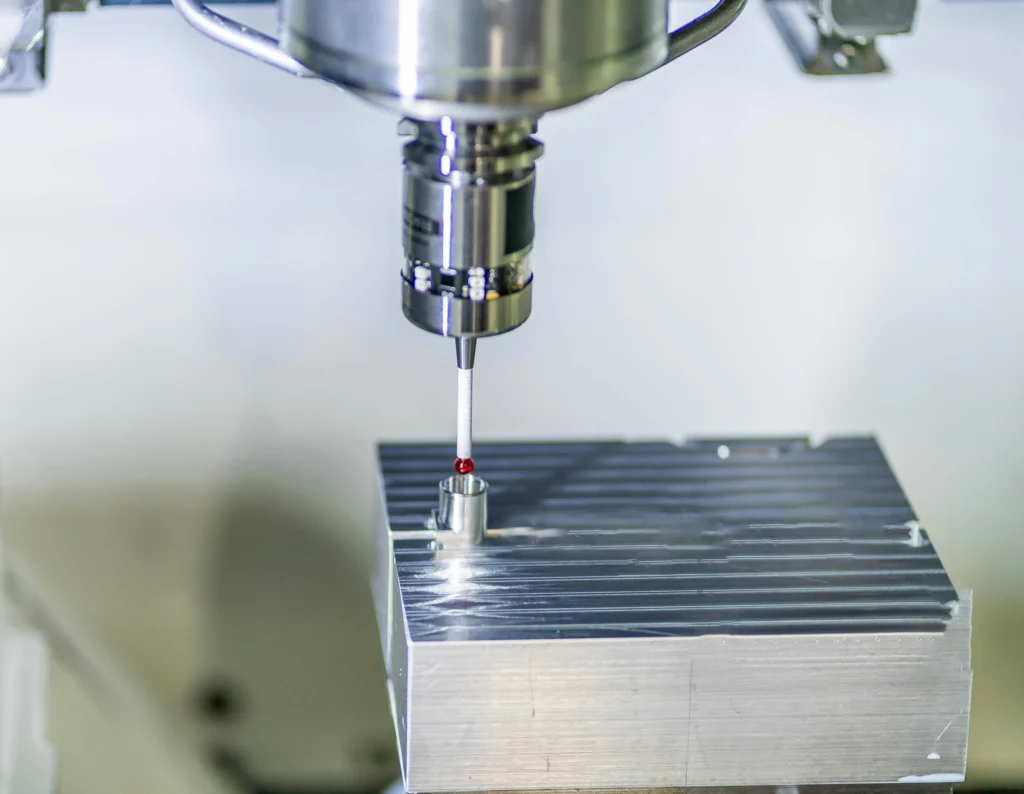
Thread inspection should not be limited to visual examination. Depending on the requirements, thread gauges and other inspection methods are used to verify whether the thread has been manufactured correctly.
In serial production, maintaining consistent parameters across the entire batch is just as important as the quality of an individual thread. Based on our 45 years of experience, the greatest challenge is not producing a single correct part but maintaining the same quality across subsequent production batches.
Achieving this requires proper process preparation, tool condition monitoring, and regular inspection of manufactured components. Selecting appropriate tolerances and quality requirements at the technical documentation stage is equally important.
We discuss our approach to quality control in more detail in the article: “Quality control in CNC machining – how do we ensure precision at SIM Gdynia?”
Summary
Threads are among the features whose quality is often fully verified only during assembly. Proper process preparation, tool condition monitoring, and effective inspection of finished parts therefore have a direct impact on component functionality.
In CNC machining, dimensional compliance is not the only requirement. A finished part must also function correctly during subsequent production stages and throughout its intended service life.
At SIM Gdynia, we provide CNC machining of threaded parts for demanding industrial applications. Contact us to discuss your project requirements.