
Deep pockets are found in many mechanical components, including housings, bodies, plates and structural parts. Machining them may seem like a straightforward milling operation, but as pocket depth increases, so do the requirements for tooling, process stability and effective chip evacuation.
CNC machining of such components requires careful process planning. Key factors include pocket geometry, tool overhang, cutting parameters and the ability to maintain stable machining conditions throughout the entire pocket depth.
Table of Contents
Why Are Deep Pockets Challenging in CNC Machining?
The deeper the pocket, the more difficult it becomes for the cutting tool to reach the machining area. Tool overhang increases, system rigidity decreases and chip evacuation from the bottom of the pocket becomes less effective. All these factors can affect surface quality and the dimensional accuracy of the finished component.
With over 45 years of experience and a machine park comprising more than 100 CNC machines and devices, we also manufacture components whose geometry requires longer cutting tools or several consecutive operations. In such cases, CNC machining requires more than a suitable program. A carefully planned toolpath strategy and the correct selection of cutting parameters are essential.
The ratio between pocket width and depth is also important. The narrower and deeper the pocket, the greater the risk of process instability and difficulties accessing corners and the bottom of the component.
Most Common Problems When CNC Machining Deep Pockets
When machining deep pockets, production challenges can affect both the cutting process and the quality of the finished component. Their significance depends on factors such as component geometry, material properties and the selected CNC machining strategy.
In practice, two areas require particular attention: maintaining stable cutting conditions and ensuring effective chip evacuation. Problems in these areas can occur simultaneously, so both should be considered during process planning.
Vibration, Long Tool Overhang and Reduced Surface Quality
Long tool overhang reduces rigidity and increases susceptibility to vibration. This can result in poorer surface quality, uneven machining marks and difficulties maintaining the required dimensions.
In more severe cases, vibration can also accelerate tool wear or cause tool damage. Therefore, when planning CNC machining operations, it is important to keep tool overhang to the minimum necessary and adjust cutting parameters to the actual operating conditions.
A similar problem occurs when machining thin-walled components, where the rigidity of the entire setup directly affects process stability. We discuss this in more detail in our article “CNC Machining of Thin-Walled Components – How to Reduce Vibration and Deformation?“
Chip Evacuation and Coolant Access to the Cutting Zone
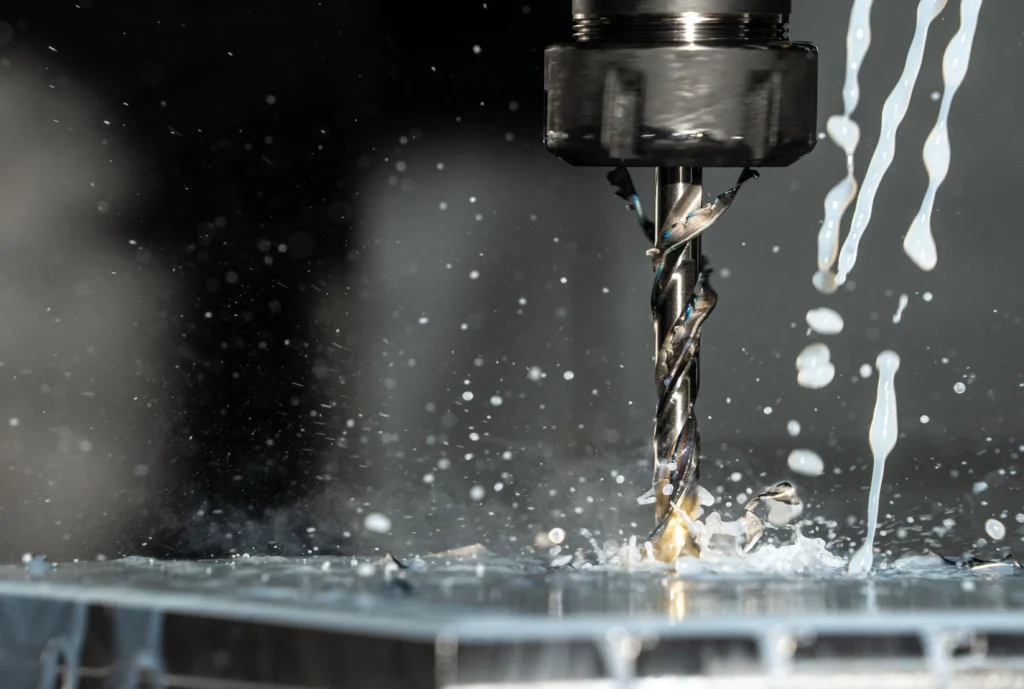
As pocket depth increases, effective chip evacuation becomes more difficult. If chips remain in the cutting zone, they may be recut, scratch the machined surface or interfere with tool operation.
Limited coolant access to the bottom of the pocket can make the problem even worse. As a result, cutting temperatures increase and machining conditions become less stable.
From our experience, simply increasing coolant flow is not always sufficient when machining deep pockets. Toolpath strategy and the proper distribution of successive cutting passes are equally important to prevent excessive chip accumulation.
How Does Deep Pocket Geometry Affect CNC Machining Preparation?
Component geometry largely determines how the machining process should be planned. Important factors include not only pocket depth but also width, corner radii, bottom geometry and tool accessibility.
Before production begins, the manufacturing engineer must assess whether the entire geometry can be machined using a single tool or whether the CNC machining process needs to be divided into several stages.
Corner Radii, Pocket Depth and Width
Small corner radii require tools with appropriately small diameters. However, as tool diameter decreases and tool length increases, rigidity is reduced, which can negatively affect cutting conditions.
For this reason, pocket geometry should be analysed as a whole. A very deep pocket with small internal corner radii may require several tools: a larger one for removing most of the material and a smaller one for finishing corners and hard-to-reach areas.
Tool Selection and Cutting Parameters
Tool selection should take into account the component material, pocket depth, surface quality requirements and chip evacuation conditions. Tool diameter, cutting length and overall tool overhang are also important.
CNC machining parameters must be adapted to these conditions. Overly aggressive settings can increase vibration and tool loads, while excessively conservative parameters do not always provide the best results in terms of production time.
In our work, we select machining strategies based on the entire setup: component geometry, material, tooling and the capabilities of the specific machine tool. Only by considering these factors together can a stable process be achieved.
How Can Deformation Be Reduced While Maintaining Component Accuracy?
Removing large amounts of material from inside a component during CNC machining changes its stress distribution and rigidity. Depending on the geometry, this can lead to minor deformation during or after machining.
The risk can be reduced by planning the correct sequence of operations, leaving sufficient material allowance for finishing passes and removing material evenly. Proper workpiece clamping is also important, as it should not introduce additional stresses.
From our experience, separating roughing and finishing operations often produces better results for more demanding components than attempting to achieve the final dimensions in a single stage. This allows the workpiece to stabilise before the final passes and improves the chances of maintaining the required accuracy.
Inspection and Repeatability of Components with Deep Pockets
Deep pockets can be challenging not only to machine but also to inspect. Limited accessibility may make it difficult to measure the bottom, side walls or dimensions located deep inside the component.
For this reason, inspection methods should be considered during process planning. Depending on the requirements, different measurement techniques may be used, with particular attention paid to dimensions and surfaces that directly affect the functionality of the finished component.
At SIM Gdynia, we have more than 800 measuring instruments, allowing us to select appropriate inspection methods for the geometry and requirements of each component. You can learn more about our approach in the article “Quality Control in CNC Machining – How We Ensure Precision at SIM Gdynia.“
In serial production, maintaining consistent conditions across successive components presents an additional challenge. Monitoring tool wear, ensuring stable workpiece clamping and maintaining repeatable CNC machining parameters help minimise differences between individual parts.
Summary
CNC machining of parts with deep pockets requires careful process preparation and consideration of several interrelated factors. Long tool overhang, difficult chip evacuation, limited coolant access and the possibility of component deformation can affect both surface quality and the dimensional accuracy of the finished part.
Proper selection of tools, cutting parameters and machining sequence helps reduce these problems and maintain process stability, even in larger production runs.
Are you planning to manufacture components with challenging geometries? Contact us and send us your project documentation.