
CNC machining of irregularly shaped parts requires careful process planning. Asymmetrical geometry, varying cross-sectional thicknesses and limited clamping surfaces can make it difficult to keep the component stable during cutting. Selecting appropriate clamping methods, cutting tools and machining parameters is therefore particularly important.
Process stability also depends on the material removal sequence, as the rigidity of the part changes along with its geometry. Taking these factors into account helps reduce the risk of vibration, deformation and dimensional deviations.
Table of Contents
Why Does Irregular Part Geometry Make CNC Machining More Challenging?
For regularly shaped components, it is easier to establish datum surfaces, provide adequate support and predict how the part will behave under cutting forces. With irregular geometry, these conditions may vary across different areas of the part.
Particular challenges arise when machining parts with thin walls, protruding features or significant differences in cross-sectional thickness. Different areas of the component have varying levels of rigidity and respond differently to loads.
Limited access to surfaces and the need for multiple setups can present additional challenges, requiring careful datum planning and maintaining accuracy between operations.
What Affects the Stability of CNC Machining for Irregularly Shaped Parts?
Process stability depends primarily on component rigidity, clamping methods and cutting conditions. For parts with irregular geometry, these factors may vary across different areas of the component.
Therefore, when planning CNC machining operations, it is necessary to consider mass distribution, accessibility of the machined surfaces and the ability to provide adequate support for the part.
Mass Distribution and Rigidity of the Component
Irregular geometry is often associated with uneven mass distribution and varying part rigidity. More substantial sections generally withstand cutting forces more effectively, while thin or protruding features are more susceptible to vibration and deflection.
The position of the machined surfaces relative to the support points is also important. If a particular feature is located far from the clamping point, cutting forces may cause greater displacement.
During process planning, it is necessary to determine which areas require additional support and how their rigidity will change as material is removed.
Part Clamping and Support Methods
The irregular shape of a component can make it difficult to use standard clamping solutions. A limited number of flat surfaces or their unusual arrangement requires an individual approach.
Depending on the part geometry, additional supports, contoured jaws or dedicated machining fixtures may be required. These help maintain a stable workpiece position during cutting.
Clamping force is also important, as it should prevent displacement without deforming less rigid sections of the part.
At SIM Gdynia, selecting an appropriate clamping method is part of process planning, particularly when CNC machining involves components with unusual geometries. Proper locating and support help maintain stability throughout subsequent operations.
Cutting Tool and Machining Parameter Selection
Even a correctly clamped part may become unstable if cutting forces are excessive relative to its rigidity.
Tool selection should take into account surface accessibility, the required tool overhang and the susceptibility of individual areas to vibration. When machining less rigid sections, it may be necessary to reduce the depth of cut or adjust the feed rate.
At SIM Gdynia, a machine park comprising over 100 CNC machine tools allows machining operations to be adapted to component geometry and technical requirements. Proper toolpath planning remains essential, as it helps minimise sudden changes in cutting loads.
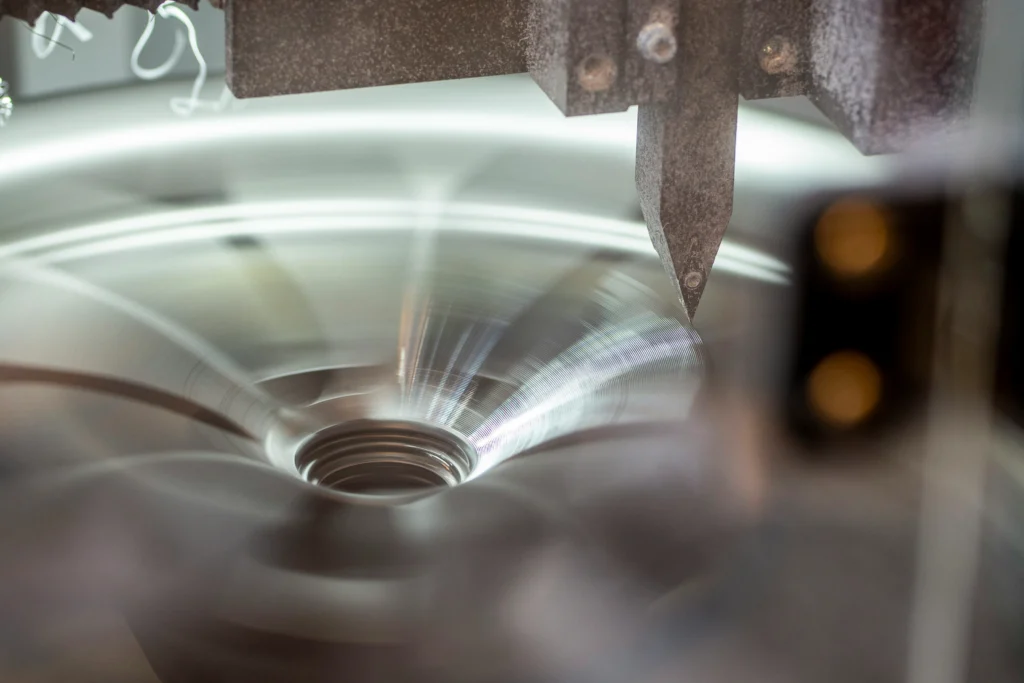
What Problems Can Occur During CNC Machining of Irregularly Shaped Parts?
Inappropriate CNC machining conditions can lead to reduced surface quality, deformation and dimensional deviations. The risk increases particularly when different sections of the part have varying levels of rigidity.
Similar challenges arise when machining components with varying cross-sectional thicknesses. We discuss methods for minimising deformation in the article “CNC Machining of Parts with Significant Variations in Section Thickness – How to Minimise Deformation?”.
Vibration and Deformation During Cutting
Vibration occurs particularly when machining thin, protruding or insufficiently supported features. It can reduce surface quality, accelerate tool wear and cause dimensional deviations.
Deformation may also result from clamping forces and residual stresses within the material. As successive layers of material are removed, component rigidity changes, potentially causing displacement in individual areas.
Cutting conditions should therefore be adapted to the current geometry and rigidity of the part, rather than solely to the material properties.
Difficulties in Maintaining Dimensional and Geometric Accuracy
Irregular geometry can make it difficult to maintain the relative position of surfaces, particularly when machining them requires multiple setups.
Even minor displacement or deformation of the part can affect the perpendicularity, parallelism or position of machined features.
Ensuring repeatable locating, stable clamping and dimensional inspection between operations is therefore essential.
How Does the Machining Sequence Affect CNC Machining Stability?
During CNC machining, component geometry and rigidity change as material is removed. An inappropriate machining sequence can make it difficult to produce subsequent surfaces to the required accuracy.
In many cases, it is beneficial to begin by machining more rigid sections and leave machining allowance for finishing surfaces that require high precision.
Thin walls and protruding features require particular attention. Removing material that provides support too early can increase the part’s susceptibility to vibration and deformation.
Separating roughing and finishing operations is also important, as it helps minimise the impact of residual stress redistribution on the final accuracy of the component.
How to Ensure Process Stability When CNC Machining Irregularly Shaped Components?
A stable CNC machining process begins with an analysis of part geometry and the identification of areas with limited rigidity. This allows appropriate datum surfaces, clamping methods and machining sequences to be selected.
For challenging components, customised clamping solutions or additional supports may be required. Proper distribution of clamping forces is also important to prevent deformation.
Cutting parameters should be adapted to the rigidity of the area being machined, as different sections of the same part may require different machining conditions.
Proper process planning reduces the risk of vibration, displacement and deformation while minimising the need for additional corrective operations.
The Importance of Quality Control in CNC Machining of Irregularly Shaped Parts
Quality control is particularly important for components whose geometry makes stable clamping and maintaining accuracy between operations more challenging.
Measurements performed at appropriate stages of production allow deviations to be detected before they affect subsequent operations. For parts susceptible to deformation, inspection after unclamping may also be important, as geometric changes previously restrained by the machining fixture can become apparent.
Particular attention should be paid to maintaining accuracy between setups, when the component must be repositioned. We discuss this topic in greater detail in the article “CNC Machining of Parts Requiring Multiple Setups – How to Maintain Accuracy Between Operations?”
Summary
The stability of CNC machining for irregularly shaped parts depends on component rigidity, clamping methods, cutting parameters and the machining sequence. Particular attention should be paid to thin and protruding features, as well as surfaces that require multiple setups.
Proper process planning and quality control help reduce the risk of vibration, deformation and dimensional deviations.
Are you planning to manufacture components with irregular geometries? Contact us to discuss your CNC machining options.